‘The UN’s sustainable development goals are like the North Star for the choices our businesses are making’ – World Brewing Alliance CEO Justin Kissinger speaks to Global Drinks Intel – Part I
By Olly Wehring
19 November 2026
‘The beer industry that existed in 2015 … was very different to the beer industry today, in terms of portfolio profile. We’ve spent a lot of that time walking people through that evolution.’
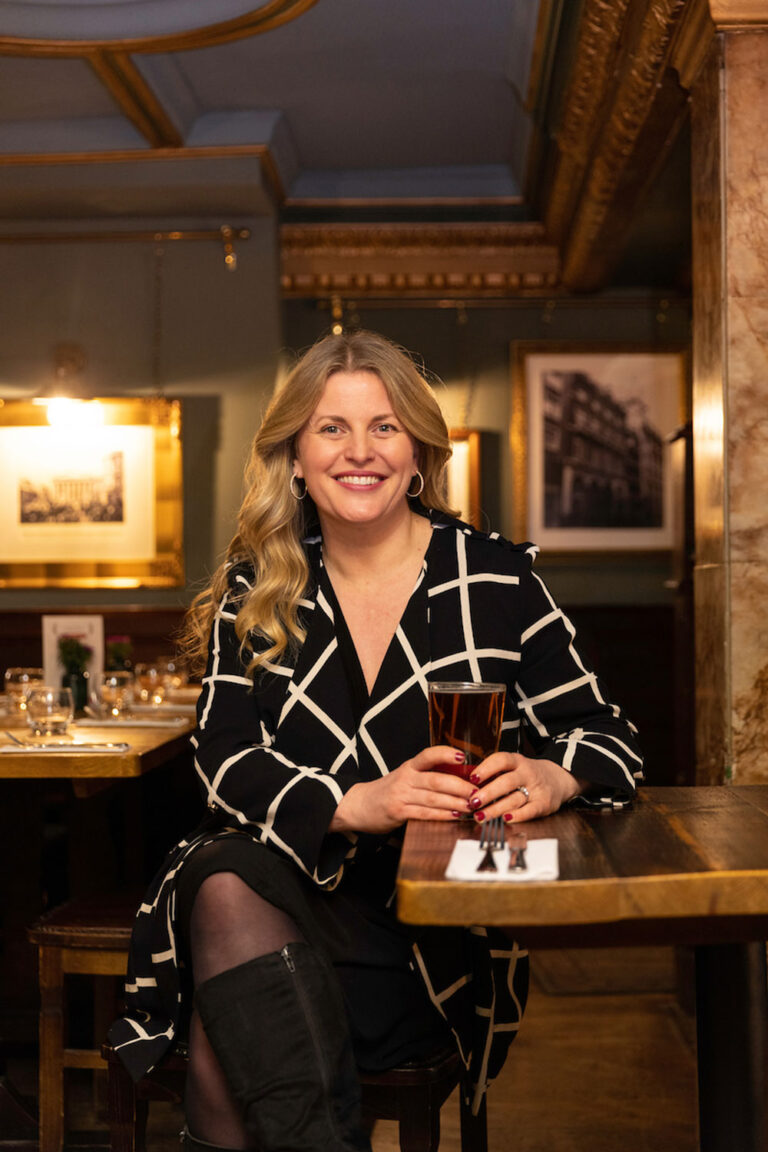
Five years ago, umbrella trade association the World Brewing Alliance underwent a revamp that included Heineken’s then-global director of public policy moving across to become its CEO. Earlier this month, Global Drinks Intel editor Olly Wehring had a call with Justin Kissinger (below), during which he learned more about that step from global brand owner to global representative organisation. Kissinger also shed light on how the organisation is set up and what its remit is – as well as who he has on speed dial.
You’ve headed up the World Brewing Alliance since 2021. What was your background?
My educational background is in law. I started my career working in a series of roles for members of the US Congress. I was with the leadership for a little while, then worked on tax issues for a member of the Ways & Means Committee from Las Vegas, before heading back to the congressional leadership.
Then, I moved to Heineken USA, where I led on government affairs and ran their Washington DC office for five years before moving to the global business in 2017. Four years later, the members of the World Brewing Alliance (WBA) decided to relaunch the organisation – that’s when I took on this current role.
What did the WBA do before its 2021 relaunch?
The organisation previously existed as a place for our trade associations and businesses to connect and talk about what’s going on in their countries. In the late 2010s, we as an industry realised we were doing so much work with international multilateral organisations, such as the UN, the WHO, the OECD, the IMF, the World Bank, that impacted our businesses.
We as an industry didn’t really have a means of effectively interacting with those organisations, which aren’t all that interested in any particular country. So we came together to use the existing architecture to give us a way of talking to these institutions about what’s great about beer and interacting on the policy issues that they drive. After all, they have a lot of influence on the policies that come through at a national or even local level.
There appear to be a few organisations out there, both nationally and internationally, that cover similar ground within our industry. Where do you sit in the pyramid?
Across beer, wine and spirits, we’re all members of the International Alliance for Responsible Drinking. That’s the organisation that’s really focused on the responsibility concept, the scientific part and the standards we want internationally for the responsible sales and marketing of beverage alcohol.
Then, you have international groups for beer, wine and spirits. Between us, the International Wine Federation (FIVS) and the World Spirits Alliance, we’re all covering diverse businesses with different issues that we’re responsive to.
What’s the WBA’s modus operandi?
It’s to be the united voice of beer – to have a point of view and a platform that is representative of beer as a category. Our core member is the product of beer.
We’re here to try to synthesise the policy positions that are beneficial to beer to the greatest extent possible; positions that identify and celebrate beer’s role in society, both now and historically, as well as its role in culture, socialisation and togetherness.
Where are your headquarters?
The model is distributed, and that’s intentional – we’re a global organisation. Our team is in at least seven cities across five or six countries. The places where we need to be are all over the world, and different regions have different needs.
We’re trying to build a global umbrella for the industry, where we can be responsive to the challenges of the day.
What’s the funding model?
The large companies contribute the bulk of our funding, and our trade association members also make a contribution every year. We try to keep things egalitarian in terms of how we fund the work that we do.
Who is number one on your speed dial?
I mean, my wife, I guess!
I spend most of my time in Geneva talking to WHO member states and in New York talking to UN member states. The IMF and World Bank are really important to us because they set a lot of the economic rules that our businesses are responding to. We also spend time with the OECD doing policy work with their group of developed economies.
Occasionally, we see the brand owners trip over each other in the quest to look to be the most ‘responsible’.
Ultimately, competitors compete. That’s what we do, right? It’s a dynamic marketplace, and all of the businesses that are working together in these trade associations are competing on the ground for every opportunity they can to build their businesses.
I don’t find it all that unusual. If you look at any other industry, there’s always competition among the people who are working together on various issues.
What has kept you busy this year?
We’ve spent a lot of time this year trying to synthesise some of the big things that have happened over the last couple of years, such as a high-level meeting on NCDs (non-communicable diseases) and, a couple of years before that, a global alcohol action plan that came out of the WHO.
There’s also an ongoing discussion – not necessarily focused on beverage alcohol but it implicates food producers as diverse as dairy all the way to soda and snack foods – about the role of the private sector in solving problems. We’ve been doing quite a bit of work to understand that debate and to give our two cents, where appropriate.
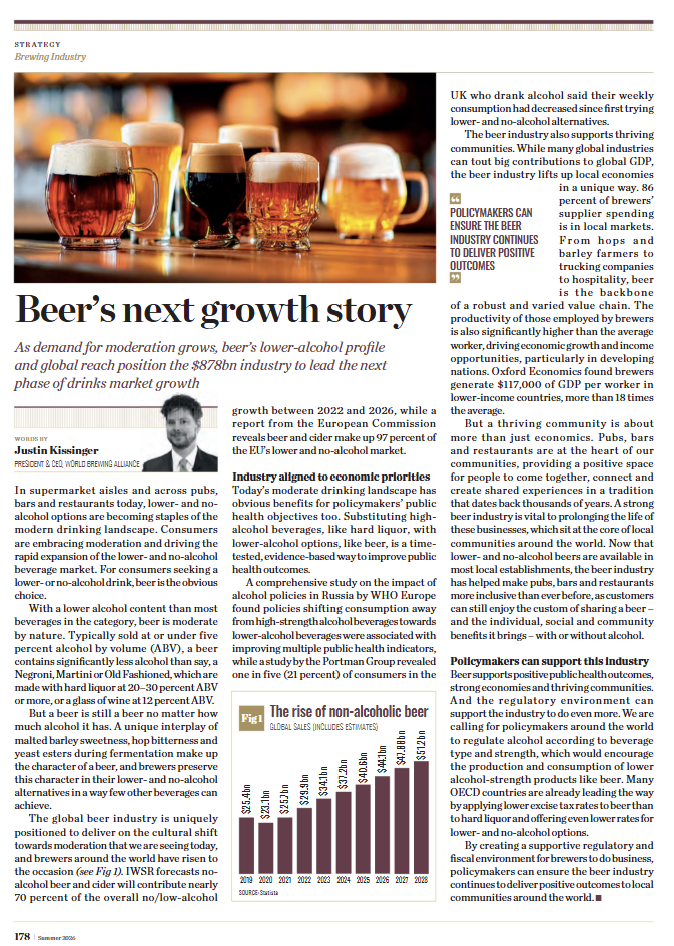
In a lot of ways, the UN’s sustainable development goals (SDGs) are like the North Star for the choices our businesses are making in terms of promoting moderation and building on responsibility. They’ve also had a big part to play in not only brewers completely reforming the types of portfolios they’re bringing to the world but also in where their growth is coming from. Right now, beverage alcohol is one of, if not the only, SDG that’s on track to meet the originally set target. We want to make sure our stakeholders are aware of that.
The beer industry that existed in 2015, when the SDGs were initiated, was very different to the beer industry today, in terms of portfolio profile. We’ve spent a lot of that time walking people through that evolution, identifying where we’ve been capturing growth, where we see future growth coming and what that means for the industry and its role in the world.
Has the increase in focus on – and sales growth from – no- & low-alcohol beer resulted in the WBA being less active than previously?
There’s always something going on that’s relevant to us. The nice thing for me is we get to celebrate growth in a direction that’s met some of the challenges that have come our way. In 2015, the world told us the goal was to create a more moderate society with less harm coming from alcohol. Subsequently, brewers across the entire sector really embarked on a relatively unique transformation of their product.
We have innovated both technologically and in terms of how we think and communicate about the product in a way that’s been really remarkable.
We’ve managed to create a whole new category that meets the needs of consumers while also creating new occasions that didn’t exist for people to step into the category. At the same time, we’ve expanded the occasions that did already exist, and we’ve provided consumers with a way of mitigating the things that can lead to harm in society.
We’re doing all of that while delivering some really high-quality liquids that people really enjoy. And we’re now distributing them all over the world.
Over the past ten years, the availability of non-alcoholic beer has gone from something that existed but that people didn’t really think about, to a consumer expectation that, when they walk into a bar or restaurant, there will be a zero-zero beer option and it will be a pleasant experience to sample it.
PART II
‘The average policymaker is probably only thinking about alcohol if they happen to be at a bar’ – World Brewing Alliance CEO Justin Kissinger speaks to Global Drinks Intel
By Olly Wehring
20 November 2026
‘It’s up to us to show people that the declines in mortality and morbidity are exceeding the declines in per capita consumption by a fairly substantial margin.’
In the second part of Global Drinks Intel‘s exclusive interview with the CEO of the World Brewing Alliance, Justin Kissinger (below) tells editor Olly Wehring about the impact the craft beer movement had on the trade association and debates what’s shaped the health & wellness trend among beer drinkers. He also divulges what keeps him awake at night.
Head here for the first part of this interview
Who do you feel has been the main driver behind moderation in beer – the consumer or the brewers?
There are more like three drivers. Everything starts with the consumer, and they want to moderate – but this isn’t an alcohol only phenomenon. The health & wellness trend spans all sorts of different industries, such as snack food, confectionery and sodas. Any of these classes of products, where moderation is something that is good on balance, has seen this consumer movement towards more moderate utilisation of the product. Different industries have adapted in different ways to this, but it’s a core consumer trend.
For brewers, we have invested collectively in making a non-alcoholic and low-alcoholic version of the product that really stands up as a fantastic exemplar of the root product. Over the past ten years, it’s gone from brewers being able to do that with just a classic lager to all sorts of different varietals of beer.
When you combine that product innovation with a distribution that’s really committed to making these available to consumers, you then have a consumer that wants the product, a product that a consumer wants, and an opportunity for them to choose that product in more markets around the world.
As that trend has turned into a lifestyle, the realisation is that this isn’t just feeding a wellness trend, it’s actually equipping consumers to enjoy the product in ways that we never really thought of them being able to enjoy it.
That then creates new opportunities for people to integrate beer into occasions that – probably for good reason – have been lost over generations. A beer at lunch in 2026 is a different type of order than it was in 2016 – and certainly than it was in 2006!
That’s a credit to the brewmasters who have made a great product, the brands that have embraced the opportunity that it comes from, and the consumers who are buying into what we’ve been able to put out.
Credit also should go to the marketers, who have communicated that this is a social norm that we want people to aspire to and to participate in.
Your job sounds like it’s become much easier over the last decade.
Don’t say that my bosses! It’s great to have a story that is responsive to the challenges of the day. That’s something the industry’s worked on collectively to meet.
What causes you to lose sleep at the moment?
It’s not a new thing for this moment, but there remains a group of people who are very passionately anti-alcohol. They’re well organised and well funded, and the things that they’re pushing for fit into some larger social trends, so there’s a new focus on it. Our challenge is to tell our story and break through to people who aren’t looking at the data every day – who aren’t walking into the bar and seeing the changes that are happening.
There is still harmful use of alcohol – We still have more to do to further eliminate it, and we need to continue to do our part to prevent any backsliding. That’s a moving target over time, but we’ve heard those challenges and have started to move in a way that addresses them.
Now, it’s about taking those trends and making sure that the people who otherwise wouldn’t be exposed to them are. The average policymaker is probably only thinking about alcohol if they happen to be at a bar. It’s up to us to show people that the declines in mortality and morbidity are exceeding the declines in per capita consumption by a fairly substantial margin.
That tells me that not only are we doing a better job of dealing with the harmful use of alcohol, but our contributions are helping accelerate that in a positive way that still maintains our businesses’ commercial priorities.
Did the craft segment of the beer industry ever cause the WBA concern?
Not really. Craft beer’s a wonderful part of the sector – A tonne of innovation and opportunity for experimentation has come from craft brewers, both of which are harder to do at large scale. While they may have been known for higher ABV products at one point, you can see just as much experimentation at lower ABV levels as well. Besides, craft is too diverse to try to ascribe any one story to the sector.
In a lot of ways, the craft brewers are the ones who ensure that the innovation cycle keeps firing. They have a lot more licence for experimentation
Is the ultimate aim of an organisation such as the WBA to lobby its way out of existence?
I wouldn’t put it in precisely those words! Our job is to help the industry meet the challenges of the stakeholder group that we’re responsive to. If they stop needing to hear from the brewing sector, only then would we stop being needed.
Beer’s been around for a very long time and policymakers have always had an interest in alcohol policy – It’s an important part of society. Our focus is on promoting moderation and celebrating the category. That’s something that, when you’re talking about a highly regulated industry, is an evergreen need.
Everything seems peaceful right now, though.
We’re certainly in a bit of an interregnum at the moment. The UN has reaffirmed that where they were going is where they want to go – That’s an important moment.
We’re also in a lot of transition. In the next six-to-eight months, both the WHO director general and the UN secretary general is going to change. So, we’re kind of at the end of one phase and about to start another. Right now, we’re waiting to see what the agenda will be for the new stakeholders who are coming into some of these offices.